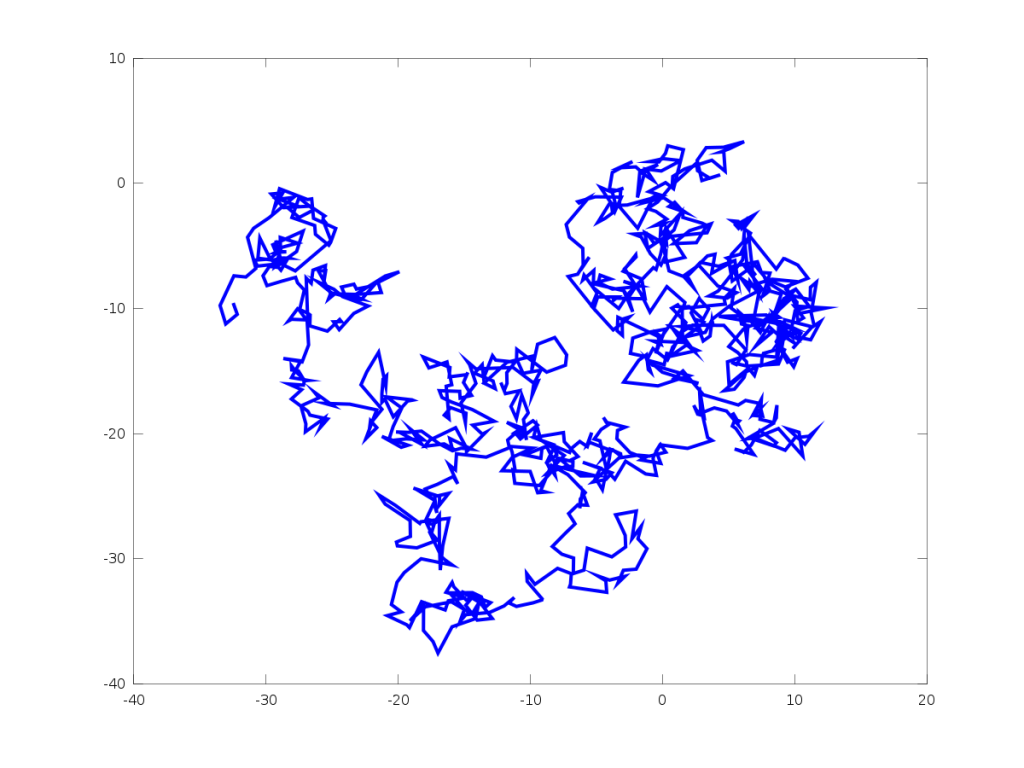
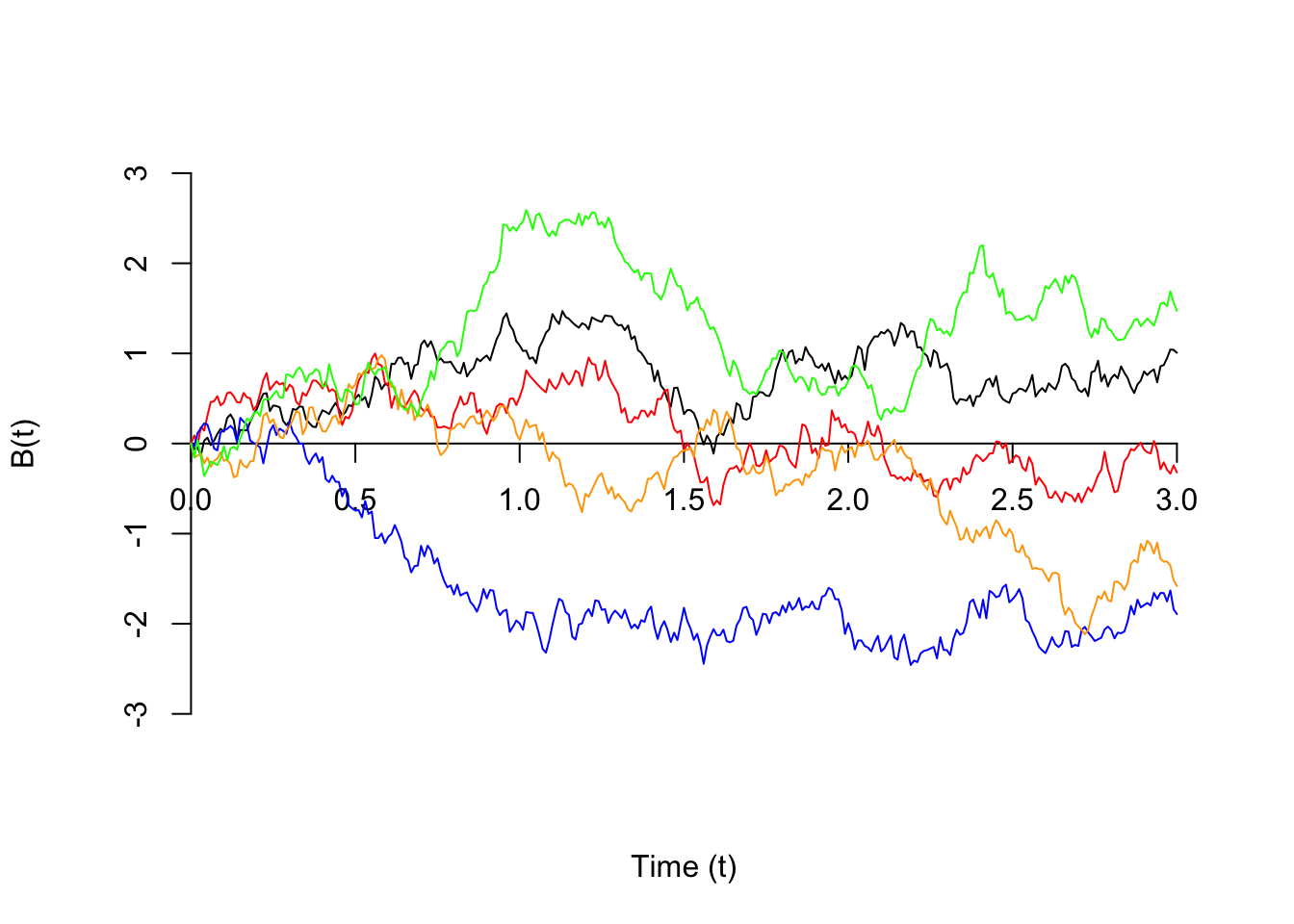
Dans la théorie des probabilités, une excursion brownienne est un processus stochastique, qui est étroitement liée à un processus de Wiener (ou mouvement brownien). Les réalisations de l'excursion brownienne sont essentiellement des réalisations d'un processus de Wiener spécifique, qui satisfait à certaines conditions. En particulier, une excursion brownienne est un processus de Wiener conditionné à être positif et à prendre la valeur 0 au temps 1. On peut aussi le définir comme un pont brownien conditionné à être positif.
Définition
Une représentation d'une excursion brownienne en termes d'un mouvement brownien W (due à Paul Lévy et notée par Kiyoshi Itō et Henry P. McKean, Jr) se donne en termes de la dernière fois que W atteint zéro, avant le temps 1 et la première fois que le mouvement brownien atteint zéro, après le temps 1:
Si est le temps auquel un pont brownien atteint son minimum sur [0, 1], Vervaat (1979) montre que
Notes et références
Bibliographie
- Chung, Kai Lai (1975). « Maxima in Brownian excursions ». Bulletin of the American Mathematical Society. 81 (4): 742–745. (ISSN 0002-9904). DOI 10.1090/s0002-9904-1975-13852-3.
- Durrett, Richard T.; Iglehart, Donald L. (1977). « Functionals of Brownian Meander and Brownian Excursion ». The Annals of Probability (em inglês). 5 (1): 130–135. (ISSN 0091-1798). DOI 10.1214/aop/1176995896.
- Groeneboom, Piet (1983). "The concave majorant of Brownian motion". Annals of Probability. 11: 1016–1027. JSTOR:2243513. lien Math Reviews. DOI 10.1214/aop/1176993450.
- Groeneboom, Piet (1989). "Brownian motion with a parabolic drift and Airy functions". Probability Theory and Related Fields. 81: 79–109. lien Math Reviews. DOI 10.1007/BF00343738.
- Itô, Kiyosi; McKean, Jr., Henry P. (2013) [1974]. Diffusion Processes and their Sample Paths. Classics in Mathematics (Second printing, corrected ed.). Springer-Verlag, Berlin. (ISBN 978-3540606291). lien Math Reviews.
- Janson, Svante (2007). "Brownian excursion area, Wright's constants in graph enumeration, and other Brownian areas". Probability Surveys. 4: 80–145. lien Math Reviews. DOI 10.1214/07-ps104.
- Janson, Svante; Louchard, Guy (2007). "Tail estimates for the Brownian excursion area and other Brownian areas.". Electronic Journal of Probability. 12: 1600–1632. lien Math Reviews. DOI 10.1214/ejp.v12-471.
- Kennedy, Douglas P. (1976). "The distribution of the maximum Brownian excursion". J. Appl. Probability. 13: 371–376. JSTOR:3212843. lien A Math Reviews.
- Lévy, Paul (1948). Processus Stochastiques et Mouvement Brownien. Gauthier-Villars, Paris. lien Math Reviews.
- Louchard, Guy (1984). "Kac's formula, Levy's local time and Brownian excursion". J. Appl. Probability. 21: 479–499. JSTOR:3213611. lien Math Reviews.
- Pitman, J. W. (1983). "Remarks on the convex minorant of Brownian motion". Progr. Probab. Statist. 5. Birkhauser, Boston: 219–227. lien Math Reviews.
- Revuz, Daniel; Yor, Marc (2004). Continuous Martingales and Brownian Motion. Grundlehren der mathematischen Wissenschaften (Book 293). Springer-Verlag, Berlin. lien Math Reviews.
- Vervaat, Wim (1979). "A relation between Brownian bridge and Brownian excursion". Annals of Probability. 7: 143–149. JSTOR:2242845. lien Math Reviews. DOI 10.1214/aop/1176995155.
- Portail des probabilités et de la statistique